01 / Infrastructure
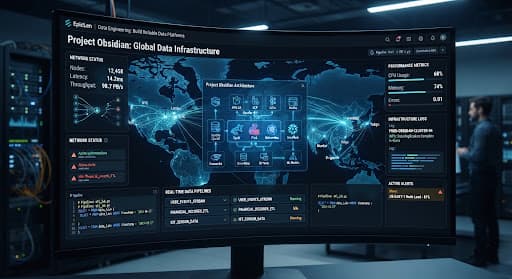
Project Obsidian
Building a real-time data ingestion engine for a global financial analytics provider.
Transform raw information into structured, searchable and scalable business assets with our engineering-first methodology.
Unstructured data is technical debt. We engineer the systems that liquidate it into intelligence.
Breaking down isolated databases into a unified, high-availability source of truth.
Automated validation and cleansing layers that ensure data integrity at ingestion.
Eliminating spreadsheets with real-time, event-driven observation dashboards.
Orchestrating complex workflows across disparate APIs and legacy environments.
Fault-tolerant orchestration that ingests, transforms, and loads petabytes of data.
Vector-optimized stores for RAG and LLM support.
Normalizing chaotic web data into high-schema, queryable relational structures.
Building low-latency full-text and semantic search engines for internal assets.
We engineer resilient scraping infrastructures capable of bypassing complex bot detection to harvest market intelligence at scale.
SELECT global crawls WHERE status active
Pinging proxy 192.168.1.1 OK
Parsing HTML tree Found 514 nodes
Extracting metadata success
Ingesting to S3 bucket epiclen-prod-raw


Mapping data sources, schema requirements, and latency SLAs.
Designing resilient pipelines and choosing the right storage engines.
Implementation of ETL logic, clean schemas, and robust error handling.
Containerized deployment with full CI/CD and monitoring integration.
Optimization for throughput growth and predictive system maintenance.
Building a real-time data ingestion engine for a global financial analytics provider.

Engineering a sub-millisecond data pipeline for algorithmic trading intelligence.
Clarifying our approach to infrastructure and deployment.
Yes. We use custom adapters and Change Data Capture mechanisms to stream data from legacy SQL, mainframes, or bespoke APIs without impacting production performance.
A standard production-ready MVP pipeline typically takes 4-6 weeks, depending on source complexity and transformation requirements.
We implement validation layers, schema enforcement, and automated unit testing for ETL transformations before they hit the warehouse.